Featured
AI and the great CMS unbundling
AI is not killing the CMS. It is unbundling creation from control. That may replace the CMS for simple publishing, but makes it more important wherever content is shared, reused, approved, or trusted.
Contents
The question I get most these days is: did AI kill the CMS? Should we still invest in a CMS, switch to AI agents, or wait until the market becomes clearer?
At a friend's birthday party recently, I was talking with engineers and startup CEOs. They were all smart people, but none of them worked in the CMS industry. From where they sat, AI seemed to make the CMS obsolete.
I understand why. AI can now generate copy, design pages, write code, translate content, and assemble websites. If that is what you think a CMS is for, it does look like the CMS is in trouble.
They may be right about one part of the CMS market. But I think they are wrong about the larger picture.
To see why, it helps to separate what a content management system, or CMS, does into two planes: the control plane and the execution plane.
The control plane governs content: who can edit it, what gets approved, which version is canonical, how translations move through workflow, and where content can be used.
The execution plane creates, assembles, and delivers that content into websites, mobile apps, feeds, and other customer experiences.
AI is unbundling these two planes. It is commoditizing the execution plane while making the control plane more valuable. That is why I think AI is killing one corner of the CMS market, but making the CMS more critical everywhere else.
§AI lowers the cost of creation, not the cost of trust
We have seen this pattern before. The printing press made it cheap to produce and distribute content, but it did not make editors or publishers irrelevant. It made them more important, because more content created more need for judgment, trust, and standards.
AI is doing something similar to digital content. It makes production cheaper: drafting, generating, translating, designing, assembling pages, and adapting content for different channels.
But AI should not be the final authority on what is correct, approved, compliant, or safe to publish. It can help, but people and systems still need to own those decisions. The more content AI helps produce and distribute, the more that ownership matters.
As production gets cheaper, control becomes more important, not less.
That is the real test for a CMS. Not whether AI can generate content or build a page, but whether your organization needs a control layer: roles, review, approvals, publishing states, revision history, and more.
§How shared is your work?
Two simple questions can help decide how much you need a CMS:
- How many people or agents create, review, and publish content?
- How many systems need to use, update, or trust that content?
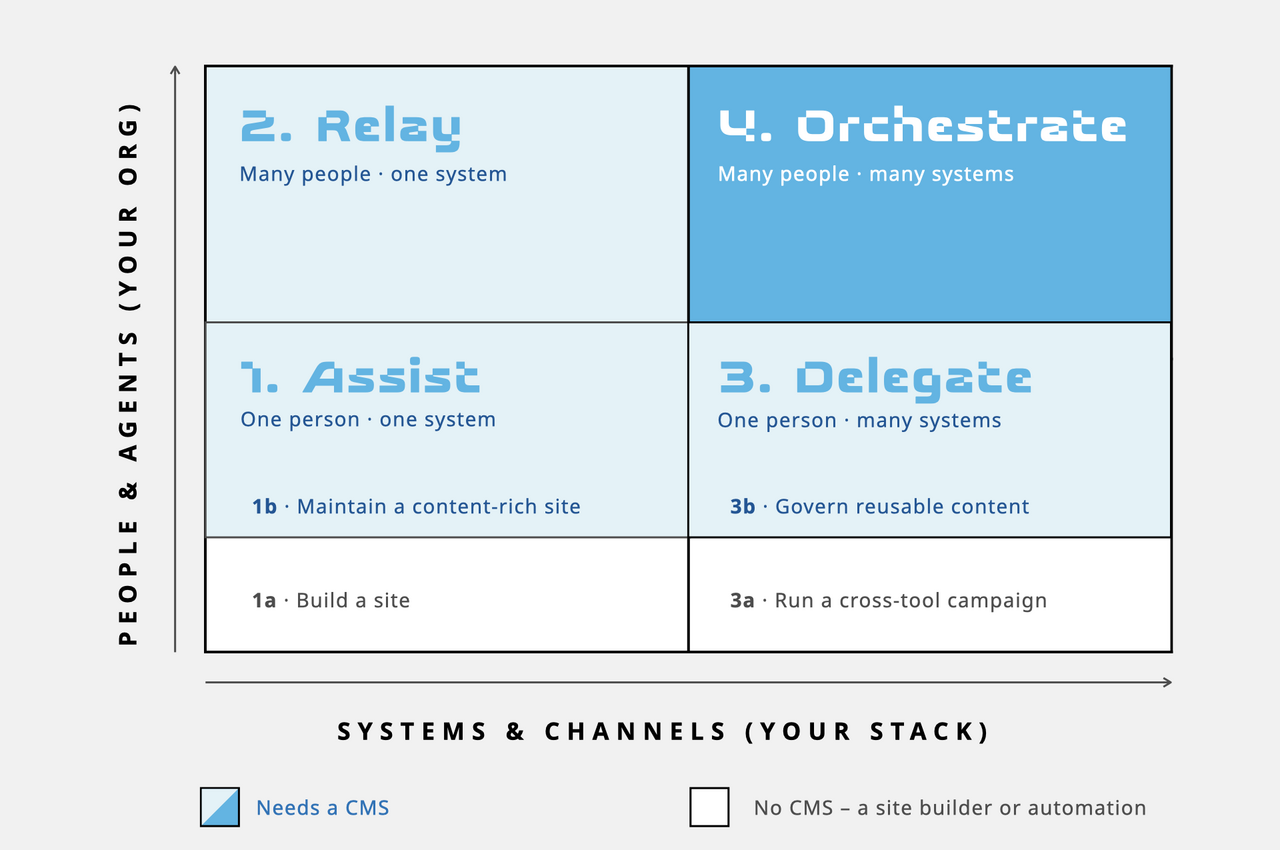
Put those questions on a grid, and four use cases emerge.
When one person creates and publishes content, and no other systems depend on it, you may not need a CMS. A lightweight publishing tool or AI site builder may be enough.
When multiple people or agents touch content, you need a CMS for coordination: roles, review, approvals, publishing states, and revision history. AI inside the CMS can help teams create, review, and publish faster without losing control.
When many systems touch content, you need a CMS as the trusted source for content, permissions, workflows, and publishing controls. AI around the CMS can coordinate work across tools, but it still depends on the CMS to know what content is approved, who can use it, and where it can go.
In short, when many people and many systems are involved, the CMS becomes a critical control layer for people, agents, and systems working together. It gives people and agents a safe place to create and approve content, and gives other tools a trusted system they can read from, write to, and build on.
§The decision, by quadrant
§1. Assist: one person, one system
This is the simplest case: one person, one system, and little coordination.
If you are creating a new website quickly, an AI site builder may be the right tool. It can turn a prompt into a working site in an afternoon. In that case, a CMS may slow you down more than it helps. This is 1a in the quadrant image.
But one person does not always mean a CMS is unnecessary.
My website has been around for more than twenty years. It has more than 1,500 blog posts and 10,000 photos. That is not just a website to create; it is a body of content to manage.
I would not move my site to a standalone AI site builder. But I do use an AI agent to work on it through Drupal: updating content, improving existing features, and building new ones.
AI helps with the execution work, while the CMS remains the control plane. This is the CMS unbundling at the smallest scale, and is 1b on the chart.
So use an AI builder when speed to a new site matters most. Use a CMS when the work is about managing a large or growing body of content over time: keeping it structured, consistent, reusable, and reliable.
§2. Relay: many people, one system
This is a clear case for a CMS.
When many people collaborate on one website, the work becomes a "relay": a designer uploads an image, a developer builds a component, a marketer writes the copy, an editor reviews the page, legal approves it, and someone presses publish.
AI does not remove that relay; it makes it move faster. The developer may use an AI coding agent, the marketer may use an AI writing assistant, and the editor may use an AI policy checker. More work moves through the same website, with less time between handoffs.
But the moment several people and several agents are working on the same website, you need a control layer to manage roles, permissions, approvals, revision history, and one source of truth.
A CMS lets teams move at AI speed without losing track of who changed what, which version is approved, and what is safe to publish.
§3. Delegate: one person, many systems
In the Delegate scenario you are still one person, so there is little coordination with other people. But the work now spans many systems: a CMS, an email marketing platform, a commerce system, a CRM, and a planning tool.
When one person spans many systems, no single product sees the whole job. The center of gravity moves to the coordinator: an automation tool that connects your systems, or an AI agent that works across their APIs.
That is why this quadrant is debatable. For a short-lived campaign, you may not need a traditional CMS. You might use an AI builder for the site and an automation tool or agent to coordinate the rest. This is 3a on the chart.
But that only works while the content is small, short-lived, and easy to manage by hand. Once the content has to be structured, reused, updated, approved, or kept consistent across systems, you need a trusted source for it. This is 3b on the quadrant image.
§4. Orchestrate: many people, many systems
This is the most complex environment, and the clearest case for a CMS.
A company campaign can involve many people and many systems at once: a marketer plans the campaign, a designer reviews the creative, legal approves the content, an editor publishes the page, marketing operations builds the email, and a commerce manager checks the discount. Every person has a role, and every system has a workflow.
AI can remove much of the coordination work: reminders, status updates, handoffs, and manual routing. But coordination is not control. Someone still has to approve the content, approve the promotion, and answer for the campaign's effectiveness.
In this quadrant, the CMS has two jobs. First, it has to govern and accelerate the work that happens inside the CMS. Second, it has to make that work usable by the broader digital ecosystem.
The CMS is not necessarily the orchestrator of that ecosystem. It is the governed workspace where people and agents can work safely, and the trusted source that other systems and agents can read from, write to, and build on.
At this scale, and at AI speed, a weak content foundation becomes expensive fast. A strong CMS is not optional.
§From unbundling to rebundling
One thing the grid does not show is where the market is moving the fastest. Right now, most of the visible energy is on the bottom row of Assist and Delegate, sections 1a and 3a, where no control plane is needed: one person using AI to create and coordinate faster.
In Assist, that means AI site builders that turn an idea into a working website. In Delegate, it means agents and automation for single-person workflows across different systems.
Lovable reportedly reached roughly $400 million in annual recurring revenue less than two years after launch. n8n raised $180 million at a $2.5 billion valuation in 2025.
But once many people are involved, individual productivity is no longer enough. Organizations need productivity, coordination, and control.
The current wave of AI site builders is mostly making one person faster. The next wave has to make organizations faster without losing trust.
AI is unbundling creation from the CMS and driving its cost toward zero. But once creation becomes cheap and abundant, the value shifts to control.
That is where rebundling starts. The next generation of products will combine AI-powered creation with a trusted control plane.
So, is the CMS dead? No. Its role is changing.
The more AI you use to create, translate, update, and publish content, the more you need a system that keeps that work structured, approved, reusable, and safe.
That means that a CMS is not a competing line item to your AI budget. It is what makes that budget pay off.
And the real risk is not that AI replaces your CMS. It is running AI without one.
AI gives you speed. A CMS gives you control at speed.
Join 5,000+ readers. I'm the founder of Drupal and co-founder of Acquia. I write about Open Source, AI, and the future of the web, with a focus on building, scaling, and thinking long-term.